

Smart Home Devices Market Growth to US$ 248.8 Billion by 2033 Driven by AI Powered Connected Living Ecosystems
Smart Home Devices Market
North America Leads Smart Home Devices Market with 34% Share Driven by High Adoption Advanced IoT Infrastructure and Strong Industry Presence
LONDON, LONDON, UNITED KINGDOM, April 13, 2026 /EINPresswire.com/ -- The smart home devices market is rapidly transforming how people interact with their living spaces, driven by advancements in connectivity, automation, and artificial intelligence. Smart home devices enable homeowners to control lighting, security, appliances, and entertainment systems through connected platforms, offering convenience, energy efficiency, and enhanced safety. As consumers increasingly prioritize comfort, control, and personalization, the adoption of smart home technologies continues to accelerate across both developed and emerging markets.
Get Your FREE Sample Report Instantly Click Now: https://www.persistencemarketresearch.com/samples/36520
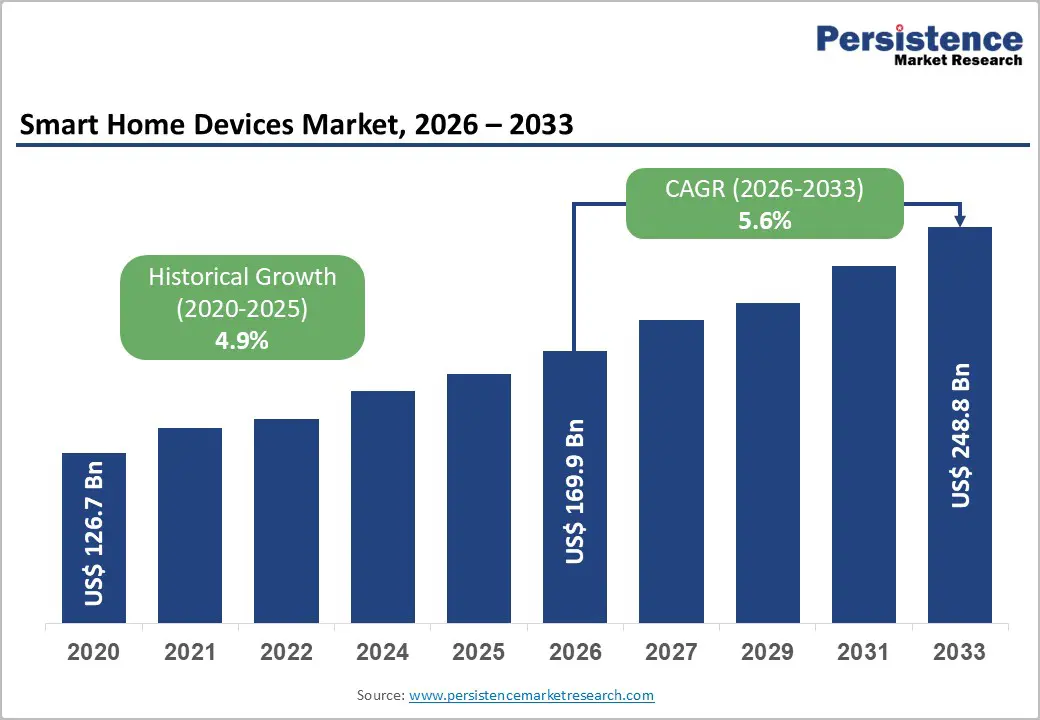
According to the latest study by Persistence Market Research, the global smart home devices market size is likely to be valued at US$ 169.9 billion in 2026 and is projected to reach US$ 248.8 billion by 2033, growing at a CAGR of 5.6 percent between 2026 and 2033, reflecting a consistent structural shift toward connected living, AI embedded home automation, and interoperable multi device ecosystems.
Rising Demand for Connected Living Solutions
One of the key drivers of the smart home devices market is the growing demand for connected living environments. Consumers are increasingly seeking seamless integration of multiple devices within their homes, allowing centralized control through smartphones or voice assistants. This trend is supported by improvements in internet connectivity, including widespread availability of high speed broadband and expansion of smart networks. Smart home ecosystems are becoming more interoperable, enabling devices from different manufacturers to communicate effectively. This has significantly improved user experience and reduced barriers to adoption.
Integration of Artificial Intelligence in Home Automation
Artificial intelligence is playing a critical role in shaping the future of smart home devices. AI powered systems can learn user preferences, automate daily routines, and optimize energy usage based on behavioral patterns. For example, smart thermostats adjust temperature settings based on occupancy and weather conditions, while intelligent lighting systems adapt brightness and color temperature throughout the day. Voice assistants and smart speakers are also becoming more sophisticated, enabling natural language interaction and integration with multiple devices.
Expansion of Smart Security and Safety Solutions
Security and safety are among the most important factors influencing smart home device adoption. Smart security systems, including cameras, motion sensors, door locks, and alarm systems, provide real time monitoring and remote access capabilities. These solutions offer peace of mind to homeowners and are particularly popular in urban environments where security concerns are higher. In addition, integration of smart sensors for smoke detection, water leakage, and air quality monitoring is further strengthening the value proposition of smart home systems.
Customize This Report for Your Exact Requirements: https://www.persistencemarketresearch.com/request-customization/36520
Market Segmentation
By Microbead Type
• Lighting Systems
• Speakers and Voice Assistants
• Thermostats and HVAC Control Systems
• Security and Access Control Systems
• Entertainment Devices
• Appliances including Kitchen and Home Appliances combined
• Others
By Product Type
• Wired Systems
• Wireless Systems
• Wi Fi
• Bluetooth
• Zigbee
• Others including Z Wave Thread and Proprietary Protocols
• Hybrid Systems
By Application
• New Construction
• Retrofit
By Distribution Channel
• Specialty Stores
• Brand Owned Stores
• Wholesale and Distributor Channels
• Online Channels including E commerce
• Others
By Region
• North America
• Europe
• East Asia
• South Asia Oceania
• Latin America
• Middle East and Africa
Growth of Wireless and IoT Enabled Devices
Wireless technology is significantly contributing to the expansion of the smart home devices market. Consumers prefer wireless solutions due to ease of installation, flexibility, and scalability. Technologies such as Wi Fi, Bluetooth, and Zigbee are widely used to enable seamless communication between devices. The rise of the Internet of Things has further strengthened connectivity across smart home ecosystems.
Influence of E Commerce and Digital Distribution Channels
The growth of online retail platforms has made smart home devices more accessible to a wider audience. E commerce channels offer consumers a broad range of products, competitive pricing, and convenient purchasing options. Detailed product descriptions, user reviews, and comparison tools help buyers make informed decisions. Brand owned online stores and digital marketplaces are also enabling manufacturers to reach customers directly, improving brand visibility and customer engagement. This shift toward digital distribution is expected to remain a key growth driver in the coming years.
Regional Market Trends and Adoption Patterns
North America remains a leading market for smart home devices due to high consumer awareness, advanced infrastructure, and early adoption of new technologies. The presence of major technology companies and strong demand for home automation solutions contribute to regional dominance.
Europe follows closely, driven by energy efficiency regulations and growing interest in sustainable living solutions. Smart thermostats, lighting systems, and energy management devices are particularly popular in this region.
Asia Pacific is emerging as a high growth market due to increasing urbanization, rising disposable income, and expanding middle class population. Countries such as China, India, and Japan are witnessing rapid adoption of smart home technologies supported by government initiatives and digital transformation.
Ready to Dive Deep? Buy Full Report Today: https://www.persistencemarketresearch.com/checkout/36520
Company Insights
✦ Samsung Electronics Co Ltd
✦ LG Electronics Inc
✦ Robert Bosch GmbH
✦ Koninklijke Philips N V
✦ Panasonic Holdings Corporation
✦ Haier Group Corporation
✦ Xiaomi Corporation
✦ Generac Holdings Inc
✦ Crestron Electronics
✦ Siemens AG
✦ Johnson Controls International plc
Future Outlook and Market Opportunities
The future of the smart home devices market is highly promising, driven by continuous technological advancements and evolving consumer expectations. Integration of artificial intelligence, machine learning, and advanced connectivity solutions will further enhance device functionality and user experience. Opportunities are expected to emerge in areas such as energy management, healthcare monitoring, and smart city integration. As interoperability improves and costs decline, smart home devices will become increasingly accessible to a broader consumer base. In conclusion, the smart home devices market is set for steady growth through 2033, supported by innovation, connectivity, and the ongoing shift toward intelligent and automated living environments.
Explore More Related Reports :
Adaptive Clothing Market
Specialty Actives in Personal Care Market
Persistence Market Research
Persistence Market Research Pvt Ltd
+1 646-878-6329
email us here
Visit us on social media:
LinkedIn
Instagram
YouTube
Legal Disclaimer:
EIN Presswire provides this news content "as is" without warranty of any kind. We do not accept any responsibility or liability for the accuracy, content, images, videos, licenses, completeness, legality, or reliability of the information contained in this article. If you have any complaints or copyright issues related to this article, kindly contact the author above.
