

The audit trail’s role in Openapi signature disputes for digital contracts
SES signature API
With dematerialisation at 78%, approval methods no longer guarantee 'non-repudiation'. The market response is API integration with OTP authentication.
You cannot build a modern digital business on analog paper foundations. eSignatures are the essential gateway to secure, efficient, and paperless enterprise transformation.”
BRUXELLES, BELGIUM, March 20, 2026 /EINPresswire.com/ -- This is in fact an unstoppable race to business process dematerialization. According to the latest European DESI indices and the findings of the Digital B2b Observatory, during 2019, more than 70% of SMEs have digitized their order cycles and contract management. But behind growth charts systemic legal vulnerability resulting from evidentiary uncertainty lies within.— Paul Thompson
The "Scanning" Paradox and the Risk of Repudiation A lot of companies mistakenly believe that scanning a hand-signed contract or receiving a simple "Ok" via email equates to solid proof before the court. Recent jurisprudence tells a different story.
In practice, most of these will fall into the weakest category of electronic signatures under EU Regulation 910/2014, eIDAS. In many cases of dispute, a mere claim of "repudiation" (a denial that the signature was applied by the user) often causes the burden of proof to shift to the company, which is compelled to undergo protracted and costly forensic analysis on original documents that often no longer exist.
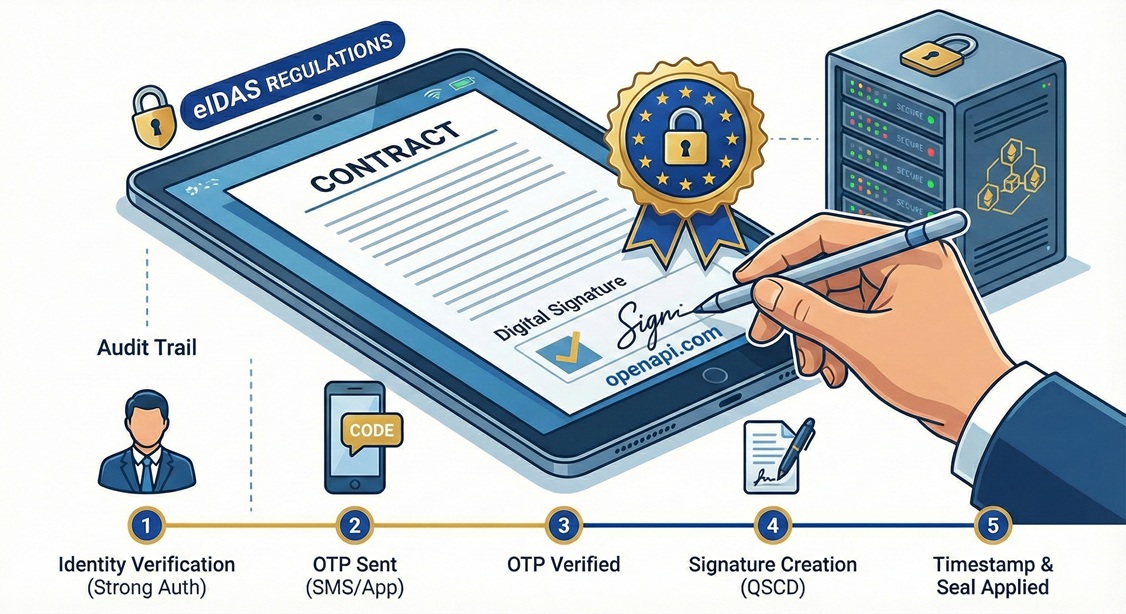
The Solution: Advanced Electronic Signature through OTP To "armour-plate" a digital contract-whether B2B or B2C-and make its legal effect and admissibility as evidence certain under Article 25 of eIDAS, the stringent demands of Article 26 of the regulation need to be met:
- Clearly identify the signatory in question.
- Sole control over signature creation data.
- Document integrity: contains detectable changes after signing.
This is where OTP or One-Time Password technology becomes the de facto standard. Sending a unique code via SMS or Email to the signatory creates the link of "sole control" required by law, substantially elevating the legal standing of the document compared to a simple signature.
"Any sensitive transaction that requires the user to be redirected to an external domain increases abandonment rates and - more importantly - it habituates users to click on external links, exposing them to phishing," explain Paul Thompson banking Cybersecurity experts.
Until recently, adopting these technologies meant fragmenting the user experience, forcing clients to exit the company website to land on third-party signing portals, local e-signature software, or products with unfamiliar URLs. In 2025, this dispersive approach comes under scrutiny from cybersecurity risk management.
Infrastructural transparency via APIs is the market response. Modern solutions, devised by tech players like OpenAPI.com or the DocuSign eSignature REST API, have intercepted this need for compliance and security. Allowing companies, via dedicated endpoints - think the protocol POST /EU-SES -, to directly integrate the signing process into their proprietary code. It's not anymore the user "going to sign", but the certified signing technology entering the corporate management software.
The Audit Trail: the contract's mysterious "Black Box" Beyond the interface, what lawyers call the Audit Trail or Preservation Log is where true legal value stands in court-not the visual PDF.
- Next-generation platforms create a technical evidentiary file that captures:
- IP addresses and Geolocation of the signatory.
- Electronic Time Stamps.
- Technical evidence of the dispatch and receipt of the OTP.
This will, of course, need to be retained for 10 years, which is the standard statutory retention period in the EU for commercial and tax records, and is the document which enables a judge to identify the chain of custody.
So in an ever more "paperless" economy, it is no longer a question of the ink that makes the difference between an enforceable debt and a null and void contract, but the quality and integrity of the metadata accompanying it.
Luca Scuriatti
Openapi Spa
email us here
Visit us on social media:
LinkedIn
Instagram
Facebook
YouTube
Legal Disclaimer:
EIN Presswire provides this news content "as is" without warranty of any kind. We do not accept any responsibility or liability for the accuracy, content, images, videos, licenses, completeness, legality, or reliability of the information contained in this article. If you have any complaints or copyright issues related to this article, kindly contact the author above.
